 by Caroline Lantuejoul
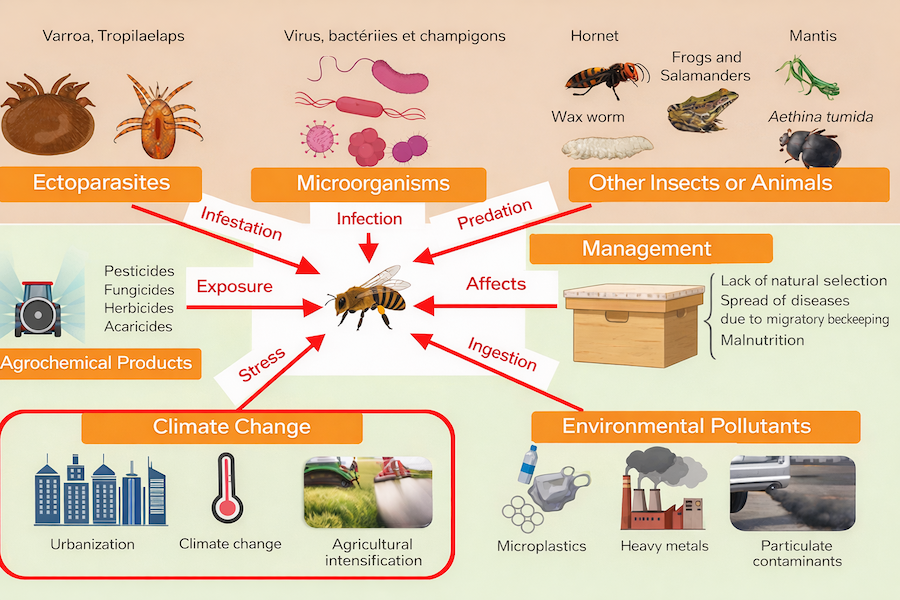
 The health of the honey bee relies on a fragile balance, constantly challenged by multiple stress factors. When this balance is disrupted, Varroa destructor is often the invisible trigger. Each year, seemingly healthy colonies collapse under the silent action of this parasite, now recognized as the leading cause of honey bee colony mortality. Too often underestimated or detected too late, varroa exploits the slightest imbalance. Identifying risk factors and implementing structured management has become essential to ensure colony sustainability.
One of the greatest challenges in managing Varroa destructor lies in its ability to go unnoticed. Although it is the number one threat to colony health, it operates in a particularly discreet manner, often deceiving the beekeeper’s vigilance during simple visual inspections of the frames. This discretion is based on two main factors: its hidden mode of reproduction and its strategic positioning on the adult bee.
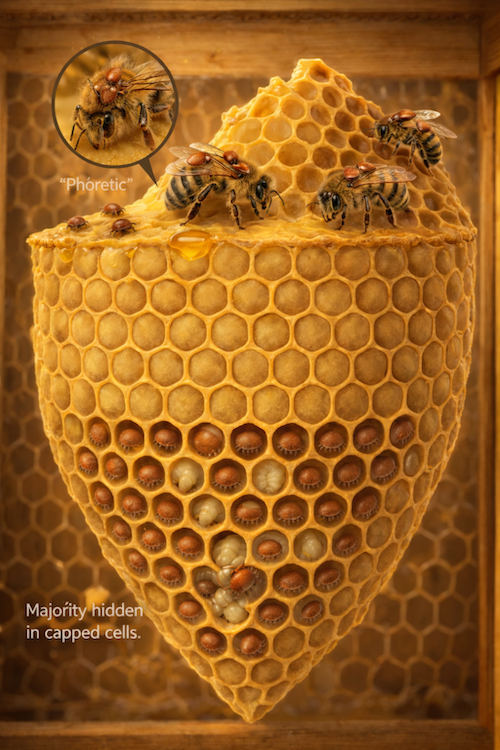
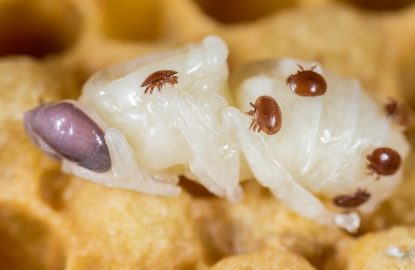
Varroa infestation works exactly like an iceberg. The visible part—the so-called “phoretic” mites that can (with difficulty) be observed on worker bees—represents only a tiny fraction of the total parasite population during the production season. The vast majority, between 50% and 90% of the mites, are hidden inside capped brood cells.
It is within this closed and invisible environment that the female varroa reproduces and feeds on developing pupae, sheltered from view and from many treatments. As a result, a hive that appears to be thriving may actually be undergoing a demographic explosion beneath its capped brood.
Even when outside the brood, on adult bees during the phoretic phase, varroa remains difficult to detect. Recent scientific findings (notably the work of Ramsey et al., 2019) have changed our understanding of the parasite’s biology. This research demonstrated that varroa primarily feeds on the bee’s fat body tissue rather than its hemolymph.
To access this resource, the mite adopts a very specific position: it shows a strong preference for the ventral side of the adult bee’s abdomen. It slips beneath the abdominal plates, an area where fat body tissue is concentrated beneath the cuticle. As a result, it is virtually impossible to spot from above when observing a frame covered with bees.
Certain visible signs within the hive may suggest a varroa infestation, even in the absence of direct observation of the parasite. Among the most indicative is the presence of bees with deformed wings, associated with the Deformed Wing Virus (DWV), which constitutes a strong warning signal. A patchy brood pattern may also reflect significant parasitic pressure, as well as abnormal mortality.
Taken individually, these signs are not sufficient to draw conclusions, but their appearance should immediately alert the beekeeper. They must be considered as indicators of a possible underlying infestation and should lead to a health assessment of the colony, along with varroa counts, in order to accurately evaluate the situation and adapt the necessary measures. This helps prevent the onset of clinical varroosis, the final stage, which is often a sign of a point of no return for the colony.
Monitoring is a key lever in apiary management, both from a health and an economic perspective:
More broadly, regular monitoring allows beekeepers to make more precise and effective decisions, thereby improving the overall profitability of the apiary.
Monitoring through mite counts makes it possible to estimate the level of varroa infestation within colonies at a given point in time. Several techniques can be used, including the observation of natural mite fall on screened bottom boards, as well as active methods such as the powdered sugar test, alcohol wash, or CO₂ method.
When carried out regularly throughout the beekeeping season, these counts become an essential tool for tracking the evolution of parasitic pressure, adapting control strategies, and intervening at the most appropriate time. They help regulate the population dynamics of the mites and delay the infestation peak as much as possible during the season, ideally until the implementation of summer treatment.
Case No. 1: On April 23, an alert was raised in an apiary of 20 colonies following the presence of several dead drones and drone pupae at the entrance of a hive, prompting concerns about the health status of one colony. A phoretic mite count was then carried out: among eight colonies tested, all showed a result of zero except this one, which reached 3.6 varroa mites per 100 bees—an abnormally high level for that time of year.
Case No. 2: On August 28, the observation of bees with deformed wings in an apiary triggered phoretic mite counts across several colonies. The results were far above normal thresholds, with one colony reaching 13.1 varroa mites per 100 bees, indicating extremely high parasitic pressure.
Several factors can contribute to the spread of varroa in the environment:
Case No. 1 – The Drifting Phenomenon: When Apiary Layout Favors Varroosis Explosion
Despite rigorous beekeeping practices (strict hygiene, regular wax renewal, and flumethrin-based treatment applied from mid-August), the sanitary situation was critical and highly heterogeneous. While some colonies showed normal parameters with moderate natural mite fall, others displayed explosive levels, reaching 110 to 200 varroa per 24 hours.
These heavily affected colonies already showed advanced clinical signs: severe depopulation, patchy brood, bald brood, and newly emerged bees that were undersized or had atrophied wings.
Clinical examination revealed that this infestation was not due to treatment inefficacy but to intense drifting caused by the spatial organization of the apiary. Some hives, highly visible in the foreground, acted as “trap colonies,” while others were less visible in the background. In dense or linear layouts, returning foragers tend to orient themselves toward the most accessible hives, typically those at the edges or in the front.
Conclusion: varroosis aggravated by drifting cannot be resolved by medication alone. Adjustments to hive layout and visual marking of hives were implemented to limit drifting behavior.

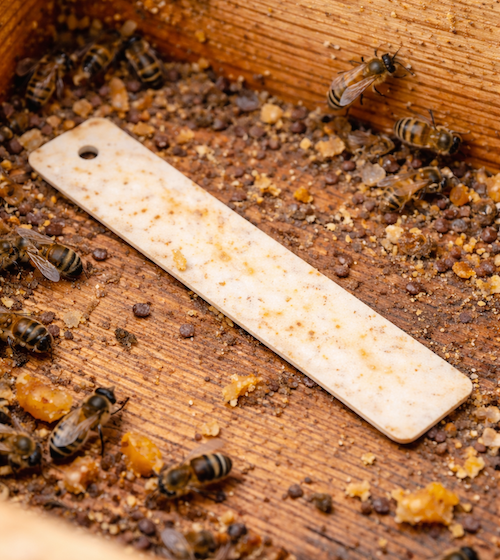
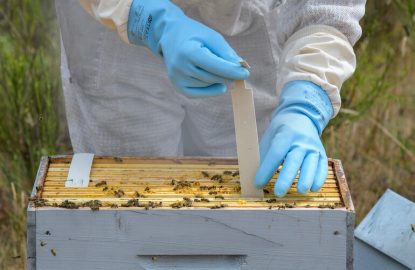
This case highlights that treatment failure is not always due to the parasite or the product itself. During a standard treatment, one of the strips had fallen to the bottom of the hive, meaning it was no longer in direct contact with the bees—and therefore with the varroa.
Mite counts on sticky boards showed a decrease in natural mite fall. The failure here was purely mechanical: the active substance could not properly diffuse within the colony.
Lesson: regular checks are essential to ensure proper strip positioning throughout the treatment period.
In two apiaries managed by a professional beekeeper, reports at the end of August indicated that a treatment was considered ineffective after one month of application. Colonies showed typical signs of late-summer varroosis, along with significant depopulation.
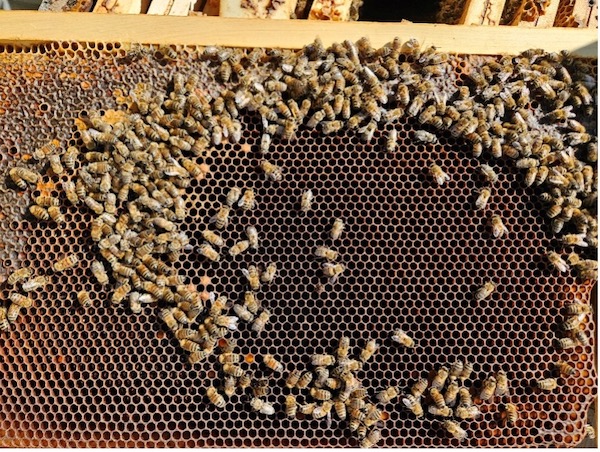
A marked decrease in newly emerged bees and nurse bees was observed, indicating a deep imbalance in colony functioning. This suggests that infestation levels were already too high by the end of July, compromising treatment effectiveness.
A reduced bee population limits contact between varroa mites and the active substance, thereby reducing treatment efficacy.

Protecting honey bee colonies in a multifactorial stress environment requires an integrated varroa management strategy. Its fundamental principle is to break away from old habits—namely, abandoning the traditional model of a single annual treatment at a fixed date.
Medication is only one tool among many. It must be supported by systematic monitoring to detect excessive infestations both before and after treatment. The beekeeper must base decisions on damage thresholds while ensuring overall biosecurity to guarantee colony sustainability.
In summary, the objective is no longer to treat “blindly,” but to build a tailored management plan based on regular monitoring and the combination of complementary tools aligned with the operation’s goals.
To learn more about integrated Varroa control and build your own control strategy, download our free guide!

References :
 by Véto-pharma
  by Véto-pharma