by Véto-pharma
 New milestone has been reached in honey labelling requirements across Europe. Since 14 June 2026, new European rules have officially entered into force to strengthen transparency in honey labelling and better protect both consumers and beekeepers. These changes are part of the revision of the EU Honey Directive (Directive (EU) 2024/1438), also known as the “Breakfast Directives”.
The objective is clear: to improve honey traceability, combat fraud, promote European beekeeping production and give consumers a clearer understanding of the origin of the honey they purchase.
Until now, honey blends marketed within the EU could still carry generic statements such as:
These descriptions provided limited information for consumers regarding the actual origin of the product.
From 14 June 2026, such generic indications must be replaced by a detailed list of the countries where the honey was harvested. This change mainly affects blended honeys sourced from several countries.
Each country listed on the label must now be accompanied by its percentage share within the blend.
Example:
Regulatory tolerance conditions for each proportion: 5%
Proportion thresholds: If a blend contains more than 4 countries of origin and the 4 main ones represent more than 50% of the composition, only their percentages are indicated. The other countries are mentioned, without percentage, in descending order.
This measure provides an unprecedented level of transparency for consumers across Europe.
The order of listing corresponds to the proportion of honey present in the product.
This rule makes labels easier to read and limits misleading commercial practices.
Important: These 3 mandatory pieces of information must appear on the front of the jar.
This measure finally harmonizes labeling rules across all European Union Member States. It applies to all honey placed on the market within the country and on the European market.
For honey packages containing less than 30 grams net weight, country names may be replaced by the corresponding ISO 3166-1 alpha-2 country codes.
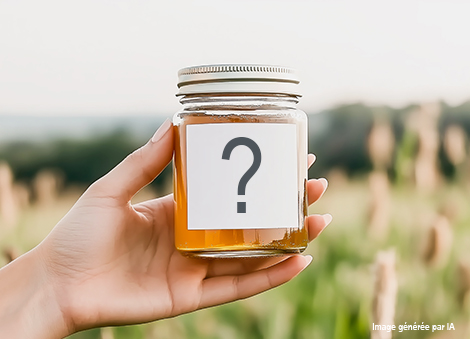
The new legislation also addresses one of the major concerns of the European beekeeping sector: food fraud.
The revised framework includes stronger control mechanisms, improved traceability throughout the supply chain and the development of harmonised analytical methods to detect adulterated honey or honey blended with added sugars.
Over time, these measures are expected to strengthen consumer confidence and provide better protection for beekeepers who comply with good production practices.
For beekeepers who market honey harvested in a single country, the practical impact is generally limited, as the country of origin is already identified on the label.
However, the new EU-wide rules provide several benefits across the European beekeeping sector:
Beekeepers and honey packers producing blends from several countries will need to update their labels to comply with the new mandatory origin and percentage requirements.
To facilitate the sale of existing stocks, honey products labelled or placed on the market before 14 June 2026, and compliant with the legislation applicable at that date, may continue to be marketed until stocks are exhausted.
Even if you market only your own harvest, take advantage of this regulatory change to check all your labels against current regulations. You can find a dedicated article on our blog.
Further information:
Official resources and useful links
• European Union: https://eur-lex.europa.eu/legal-content/EN/TXT/HTML/?uri=OJ:L_202401438
• Apimondia: https://apimondia.org/eu-new-rules-for-honey-labelling/
• EBA: https://ebaeurope.eu/the-origin-of-honey-blends-will-finally-be-clearly-labeled/
 by Véto-pharma
  by Véto-pharma