 par Gérald Therville
 This article was co-authored with Dr Gérald Therville, an apicultural veterinarian based in Maine-et-Loire, France, who holds a postgraduate diploma in apiculture.
Drawing on a study conducted in the summer of 2023 to monitor infestation levels and manage high parasite burdens, we describe the control methods implemented during the trial and how they were subsequently adapted for use by a part-time commercial beekeeper whose production colonies maintain continuous brood rearing throughout the season.
As highlighted in a previous article (Strong colonies and varroa infestation: the hidden cost of high productivity ), the conditions that promote rapid brood expansion also create an ideal environment for the proliferation of Varroa destructor. This creates a paradox: colonies with abundant brood and strong honey production often carry higher parasite loads by the end of the season, with important implications for their management.
Once infestation exceeds a certain threshold, varroa negatively affects colony health and performance throughout the season. Before a complete colony collapse occurs, several warning signs may be observed, including reduced productivity, colony weakening, brood disorders, and, of course, elevated mite counts.
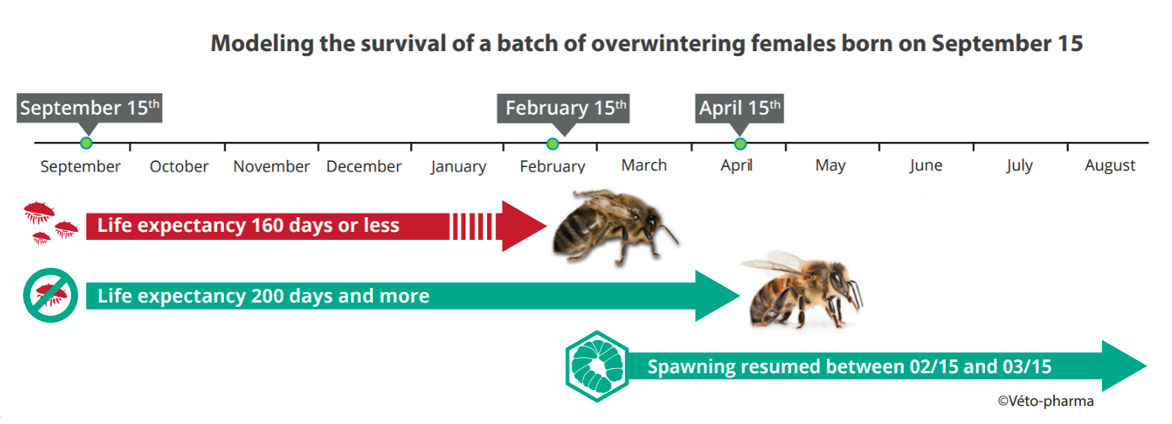
During summer, colonies begin preparing for winter by producing the winter bee population. The impact of varroa on these bees can irreversibly compromise both their survival and that of the colony as a whole.
In the summer of 2023, we monitored 36 honey bee colonies belonging to two different beekeepers, each following distinct management practices. Regular inspections and weekly mite counts based on natural varroa drop on monitoring boards were carried out, starting on 12 August, prior to treatment. Table 1 presents the counting results by group and by colony. Group 3 consisted of nucleus colonies established in early June from a single brood frame, while Group 4 comprised production colonies that underwent two drone brood removals during the season.
Using an average critical threshold of 10 Varroa mites per day at that time of year, we identified the colonies at greatest risk and requiring urgent treatment, primarily the production colonies, where there had been no brood interruption.
The first observation was that the level of infestation was closely linked to the colonies’ management history, with significantly higher parasite loads in production colonies than in late-season nucleus colonies. This finding highlights the value of managing colonies in groups in order to tailor monitoring and treatment strategies accordingly.
For the heavily infested colonies, and considering the time of year, we chose to begin with a fast-acting treatment capable of reaching Varroa mites within capped brood cells: formic acid. Seven days later, amitraz-based strips were applied to provide a longer-term follow-up treatment, with a treatment duration of ten weeks.
For the less heavily infested colonies, treatment with amitraz strips was applied directly, as the infestation level was considered manageable using a slow-release treatment.
Group | Hive no | Observed mite fall during pre-treatment counts (15 days bedore treatment) | Observed mite fall during treatment |
GROUP 3 | 23 | 42 | 137 |
24 | 60 | 974 | |
25 | 55 | 327 | |
26 | 802 | 4847 | |
27 | 98 | 167 | |
28 | 126 | 613 | |
29 | 22 | 1859 | |
GROUP 4 | 30 | 169 | 688 |
31 | 789 | 3579 | |
32 | 159 | 831 | |
33 | 722 | 2905 | |
34 | 805 | 4269 | |
35 | 1136 | 3946 | |
36 | 573 | 2130 |
Table 1 : Mite counts in two colony groups : cumulative Varroa mite fall recorded during the 15-day pre-treatment monitoring period and during treatment. Relationship between predictive infestation indicators and the mite fall observed during treatment.
The following spring, two colony losses were recorded: one drone-laying colony in Group 3 and one dead colony in Group 4. The remainder of the apiary stock resumed the season normally, with Varroa mite counts remaining within the expected range.
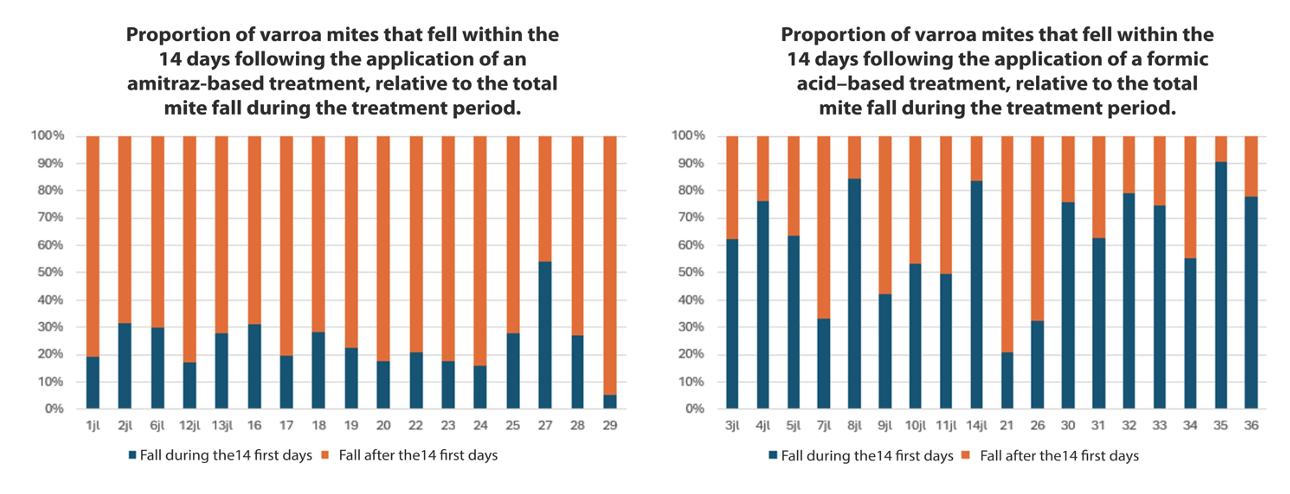
These graphs, derived from a comparative field trial, illustrate the Varroa mite fall dynamics under a fast-acting treatment versus a slow-release treatment. A rapid initial response can be observed with formic acid, in contrast to the more gradual effect of amitraz-based strips during the first fifteen days of treatment. These differences are explained by the distinct modes of action of each active substance.
Although no immediate queen losses were observed following the application of formic acid, this risk had been anticipated. The beekeepers closely monitored any signs of supersedure and requeening, with replacement queens available if required. Most queens were one year old. No other adverse effects were reported.
The objective is to begin late-summer colony management with an acceptable parasite load, while limiting the impact of the parasite on the production of winter bees. Earlier Varroa management during the beekeeping season should be prioritized whenever possible, although it remains challenging to implement in continuous brood-rearing systems.
Without going into detail on the impact of viruses, it is important to emphasize that a rapid reduction in Varroa pressure also helps limit the development of viral loads associated with Varroa destructor.
The beekeeper operates on a part-time basis. He overwintered 88 colonies in 2025, of which approximately two-thirds were production colonies from the previous season and one-third were dedicated to colony replacement and stock renewal.
Having been monitored for several years, he regularly migrates apiaries of around twenty colonies to successive nectar flows, including oilseed rape, black locust (acacia), linden, sweet chestnut, sunflower, and occasionally buckwheat, resulting in a honey production of approximately 2 tonnes in 2025.
His Varroa management strategy has evolved over time. After experiencing substantial colony losses under a simplified organic treatment approach, he transitioned to a more conventional control program, based on amitraz strips in late summer followed by oxalic acid trickling during the winter broodless period.
Specific Features of the Operation:
The beekeeper wishes to avoid time-consuming biotechnical control methods. Consequently, queen caging and brood removal have been ruled out. For colony renewal, he continues to rely on the purchase of mated laying queens, without using ripe queen cells or queen cells ready to emerge.
Hive / Nucleus Colony ID | Treatment with Flumethrin Strips (26 & 29 August 2024) | 1st Count – 10 Days After Treatment 10/11/2024 | 2nd Count 15 Days After the First Count 25/11/2024 |
Nucleus Colony 24 | Yes | 0 | 0 |
Hive V12 | Yes | 0 | 0 |
Hive 59 | Yes | 4 | 6 |
Nucleus Colony 11 | Yes | 0 | 15 |
Hive 48 | Yes | 27 | 17 |
Brown House Hive | Yes | 0 | 3 |
Hive V – Blue House | Yes | 3 | 0 |
Yellow House Hive | Yes | 2 | 6 |
Hive V11 | Yes | 0 | 1 |
Table 2 : Residual infestation assessments were initiated 10 days after the end of treatment and continued for 15 days during the winter of 2024. A number of colonies exceeded 0,5 Varroa mites per day, which is generally considered the target threshold for this periode of the year. These findings prompted a reassessement of the overall Varroa management strategy.
Late Nectar Flows: Natural or artificial nucleus colonies that have already undergone in-season Varroa management are used according to their stage of development. A pre-deployment mite count is performed to select the least infested colonies before migration. Long-acting treatment strips are applied upon their return. In 2025, no late nectar flow occurred, as honey production ended around 15 July due to drought conditions.
Note: The beekeeper provided rapid and substantial feeding immediately after honey supers were removed, including protein supplementation in August 2025.
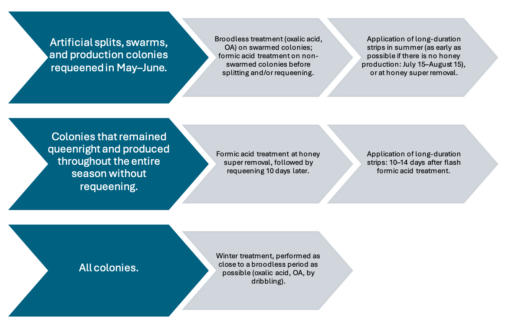
Regarding mite counts: in addition to spring monitoring, an assessment in late June–early July would help refine risk evaluation before summer treatments. Managing colonies in batches facilitates representative sampling according to their management pathway. For colonies intended for a late honey flow, a pre-selection count is essential to identify the least infested colonies, ideally within groups already monitored during the season.
The beekeeper provided the results obtained following the winter treatment. All colonies were evaluated according to the methodology presented in Table 3.
Formic acid was applied in accordance with the recommendations from the manufacturer based on a recent field trial: a first strip was applied, followed by a second strip five days later. Amitraz- and oxalic acid-based treatments were used in accordance with their respective marketing authorizations.
Fifteen colonies headed by older queens (red-marked queens in summer 2025) exhibited supersedure following formic acid treatment. As their replacement had already been planned, the beekeeper had been informed of this known risk beforehand. A pharmacovigilance report was submitted.
Hive/ NUcleus ID | Formic Acid Treatment | Amitraz Treatment | Oxaliq Acid Treatment | Count D+7 11/01/2026 | Count D+14 18/01/2026 | Count D+36 07/02/2026 |
Hive V5 | 30/07/2025 au 02/08/2025 | 09/08/2025 | 02/01/2026 | 20 | 2 | 0 |
Hive 62 | 48 | 2 | 2 | |||
Hive V10 | 6 | 0 | 0 | |||
Hive 61 | 28 | 10 | 1 | |||
Hive 23 | 9 | 0 | 1 | |||
Hive 63 | 47 | 6 | 0 | |||
Hive 40 | 05/08/2025 | 9 | 2 | 0 | ||
Hive 38 | 35 | 2 | 0 | |||
Hive V12 | 0 | 0 | 0 | |||
Hive 6 | 130 | 14 | 7 | |||
Hive 3 | No treatment | 26 | 2 | 0 |
Table 3 : Monitoring of mite fall following winter treatment and during spring. Note Hive 6 at the bottom of the table: approximately 0,5 varroa mites per day were recorded on 7 February, together with relatively high mite fall following the winter treatment.
Of the 88 colonies overwintered, ten showed more than 50 varroa mites following application of the oxalic acid-based treatment (11% of the colonies). These colonies were identified and included among the first groups scheduled for treatment after the oilseed rape honey flow, together with requeening. At the 7 February count, two of these colonies exceeded the threshold of 0.5 varroa mites per day (Tables 3 and 4), while the remaining colonies fell within the expected range.

Table 4 : Hive 50 showed high mite fall following the winter treatment, with infestation levels remaining elevated in February. The colony was still alive and developing well at the March inspection, but it has been identified as a high-risk colony.
Spring 2026 assessment: at the March inspection, three colonies had died—one colony with a failing queen, already identified in the autumn, and two colonies showing delayed development despite one-year-old queens, with no signs of disease (these colonies will be requeened). An additional ten colonies from the same group, headed by two-year-old queens, also exhibited slower development without any signs of disease. These colonies were clustered within the same apiary.
The proposed protocol addresses the beekeeper’s specific needs with a clear objective: regardless of the management pathway of the colonies, to enter the summer long-duration treatment period with the lowest possible parasite pressure. This approach is based on a multifactorial strategy—Varroa management, nutrition (syrup and protein supplementation), genetics, and control of the yellow-legged hornet—all of which act together to reduce stress factors affecting colony health.
The current monitoring strategy relies on mite counts conducted during winter and spring. Introducing additional assessments at key points in the season—particularly prior to summer treatments, in late June or early July—would allow for a more refined risk evaluation and better-informed treatment decisions. This represents a practical and readily implementable addition that would not significantly disrupt the existing management system.
The operational constraints of the apiary, notably the absence of in-season biotechnical control methods, remain an important consideration. Within this framework, establishing a dedicated drone-producing apiary, combined with brood removal from production colonies, could offer several advantages: improved control of parasite pressure, potential use of queen cells, and enhanced genetic management through on-site mating. Appropriate medicinal support would need to be defined as part of such a system.
It is precisely in this type of approach that the role of the bee veterinarian becomes most valuable: proposing realistic adjustments that take field constraints into account while optimizing the long-term sanitary and zootechnical performance of the operation.
 by Caroline Lantuejoul