by Véto-pharma
 In the fast-paced world of commercial beekeeping, timing and colony strength are everything. For queen breeders and package / nuc producers, the ability to raise healthy queens and produce strong, vibrant bee packages / nucs depends heavily on the nutritional status of their colonies. In fact, the nourishment provided to the queen during their development, from the embryo to the mated queen stage, is a critical factor affecting the growth and survival of the colony. While nectar provides carbohydrates for energy, protein is the building block of brood rearing, hypopharyngeal gland development, and overall colony vitality. That’s where targeted protein supplements, especially premium formulations like MegaBee, can make a measurable difference in productivity and success.
Honey bees require protein primarily for brood production and the maintenance of the colony balance. In nature, protein comes from pollen, but pollen quality and availability fluctuate dramatically with seasons, weather, and floral diversity. During pollen shortages, such as early spring build-up or late-season, supplementing with a high-quality protein source ensures bees have the amino acids they need to thrive.
One of the most crucial structures affected by protein intake are the hypopharyngeal glands. Found in the head of nurse bees, these glands produce royal jelly, which is essential for feeding larvae and queens. Well-developed hypopharyngeal glands mean nurse bees can produce more abundant and nutrient-rich brood food (royal jelly), directly supporting healthy queen development and robust brood rearing. Without adequate protein, these glands atrophy, leading to weaker brood and reduced colony growth potential.
Queen rearing is a social effort, and the worker’s decision to rear a queen is made collectively. The decision is complex and influenced by several social and physiological factors, including the number of bees in the group, the age of the larvae and the nutritional stage of the colony. In fact, queen rearing is one of the most nutritionally demanding activities in beekeeping. Young larvae destined to become queens are fed exclusively on royal jelly, requiring huge amounts of protein-rich secretions from nurse bees.
To produce top-quality queens with large ovaries, strong pheromone output, and high egg-laying capacity, the nurse bees themselves must be in peak condition. Indeed, nurses cannot sustain the laying of the queen under a carbohydrate diet alone. Queen reserves are not sufficient to sustain her high egg-laying rate, so that, the queen relies on continuous jelly feeding by her nurses.
Well-nourished queens develop large ovaries and a more efficient spermatheca, allowing them to store greater amounts of viable sperm and this results in more abundant and long-lasting egg-laying. In addition, nutrition directly affects the size, viability and consistency of the eggs. Well-fed queens show more uniform laying patterns, with fewer gaps, an indicator of good health and fertility.
Queens raised with proper nutrition emit stronger sexual pheromones, attracting more drones during the mating flight. This enhances genetic diversity within the colony and strengthens its resilience.
When colonies are supplied with a high-quality protein supplement, nurse bees maintain large, active hypopharyngeal glands, ensuring the developing queens receive optimal nutrition. The result: queens that are better mated, longer-lived, and capable of laying more eggs, qualities highly valued by breeders and buyers alike.
Producing packages / nucs requires colonies to generate large populations of healthy young bees within a short timeframe. Package bees / nucs need to be strong, well-fed, and stress-resistant, as they face transportation and the challenge of establishing themselves in a new hive.
Here, protein supplements play a critical role by:
Simply put, without sufficient protein, package / nuc producers risk shipping bees that are underweight, short-lived, or less productive in their new homes.
While there are various protein supplements on the market, MegaBee stands out for its scientifically formulated balance of amino acids, high digestibility, and proven performance in stimulating brood rearing. Developed through USDA research, MegaBee is designed to mimic the amino acid profile of high-quality natural pollen, making it especially effective for maintaining nurse bee health and productivity.
Queen breeders using MegaBee often report:
Package producers note:
How? Well, it all comes down to the hypopharyngeal glands.
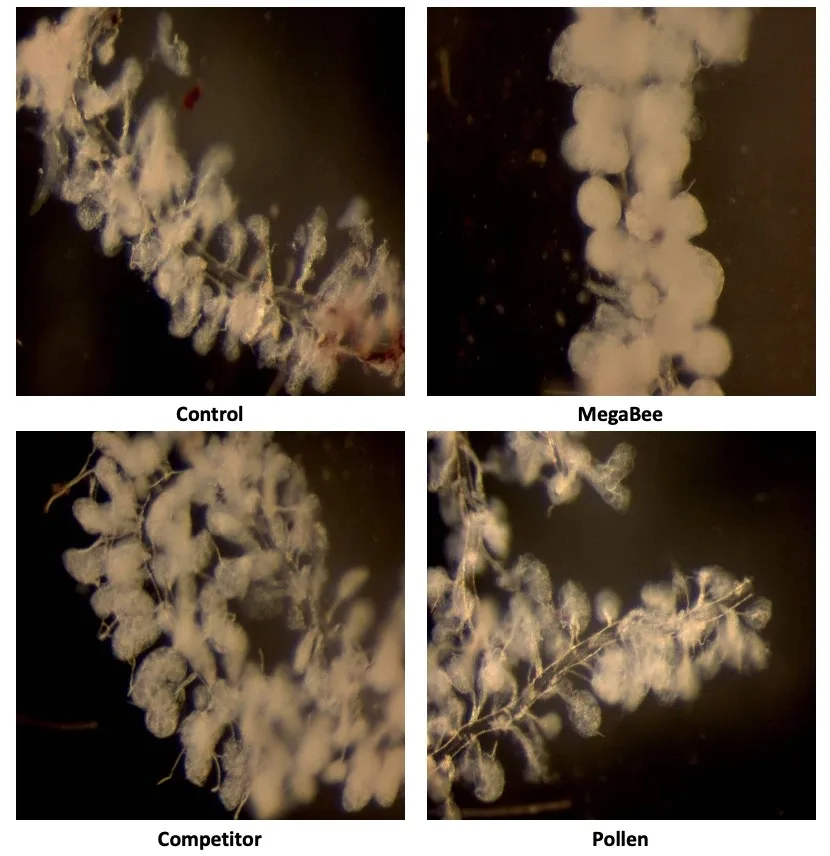
In young nurse bees (around 5–10 days old), the hypopharyngeal glands reach their peak size and secretory power, looking under a microscope like clusters of grapes, with each “grape” representing a functional acinus. As bees age and switch from nursing to foraging, the glands shrink and shift to processing nectar sugars instead. This means gland size and activity are directly tied to a bee’s age, role, and, most importantly, its nutritional status.
Protein intake is the deciding factor. A steady, high-quality protein supply allows nurse bees to keep their glands large and active for longer, enabling them to feed not just the larvae but also other castes in the colony. This leads to overlapping generations of well-fed, long-lived bees, a key driver of colony strength and resilience. In protein-poor colonies, the opposite happens: brood rearing slows, bees start foraging too early, and overall lifespan drops.
In one study, researchers tracked hypopharyngeal gland development in 100 newly emerged bees split into four groups:
Week 1: All protein-fed groups had fully developed, lobular, opaque glands, ideal for brood feeding.
Week 3: Control and competitor-fed bees had shriveled glands, showing they had transitioned early to foraging. In contrast, MegaBee and pollen-fed bees still had active glands.
Week 4: Only the MegaBee group maintained viable glands capable of producing royal jelly.
—
Another study by DeGrandi-Hoffman et al. (2010) confirmed the pattern: MegaBee-fed bees matched pollen-fed bees in both protein levels and gland acini size, clear evidence that MegaBee sustains the physiological machinery behind brood rearing and queen production.
Blood protein (haemolymph) analysis told the same story: MegaBee-fed bees had even higher protein levels than the pollen-fed group.
In 2016, Gordon Wardell (the developer of MegaBee) was raising queens for a large beekeeping operation in the USA. The numbers looked good on paper: a high volume of mated queens leaving the operation. But in the field, their success rate in colonies was underwhelming.
His team was skeptical that nutrition could be the issue. Colonies were bringing in plenty of pollen from citrus, palmetto and wildflowers. Wardell suspected otherwise and set up a controlled trial.
All queens were raised under identical conditions, with MegaBee provided in the cell builders and finishing colonies. The only variable was the mating nucs: half received ~100g of MegaBee patty (replaced weekly), the other half received no supplement. Hive beetle pressure dictated the small dose.
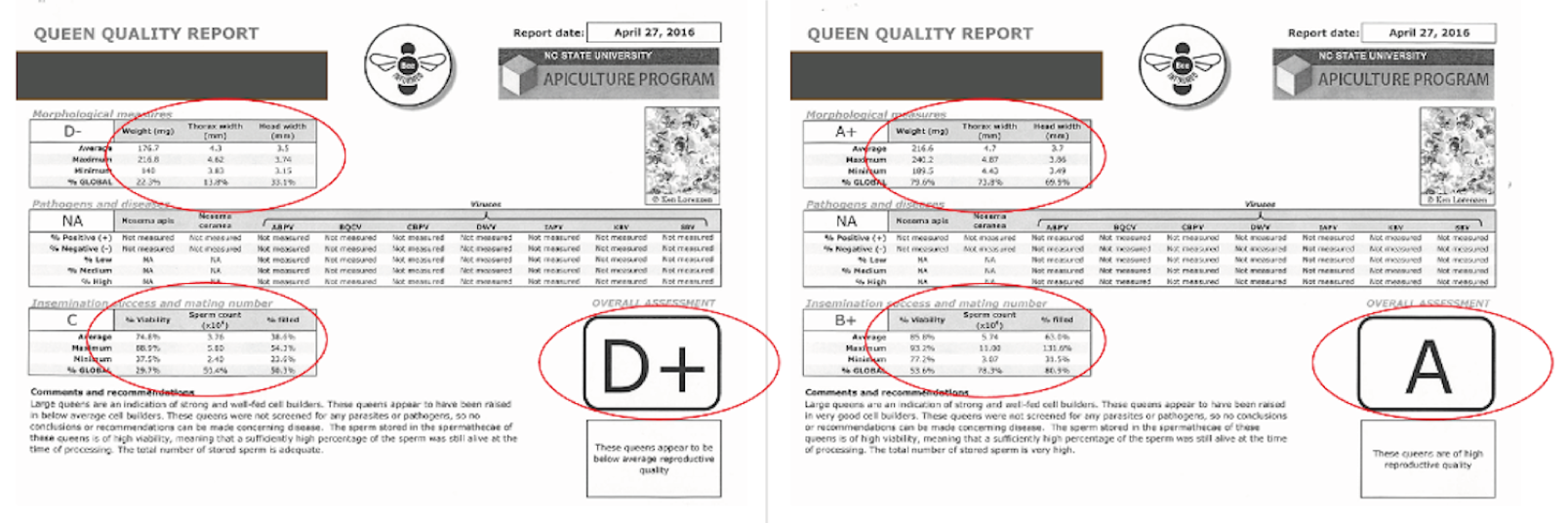
Each batch of queens was then sent to an independent university lab for blind analysis: body weight, thorax weight, sperm viability, spermatheca fill rate and disease screening.
The results were unambiguous. On the lab’s A-to-F scale:
Wardell’s interpretation: once queens emerge in mini-nucs (roughly 1/8 the size of a full colony), nurse bees in supplemented colonies produced more royal jelly for longer, feeding emerging queens better. Better-fed queens develop stronger flight muscles, mate more successfully and store more viable sperm in their spermatheca.
The operation adopted MegaBee feeding in mating nucs as standard protocol from that point on.
—
What this case highlights is that even small, targeted feeding interventions (in this case, just the mating nucs) can transform queen quality, even when natural pollen flow appears sufficient. The lesson is less about quantity than about consistency at every critical stage of queen development.
For queen breeders and package or nuc producers, productivity hinges on the ability to raise strong bees quickly and reliably. Protein is the foundation of that success, fueling hypopharyngeal gland development, brood production, and colony resilience. While natural pollen is ideal, it is often inconsistent, making supplements like MegaBee a powerful tool in the beekeeper’s arsenal.
Ready to strengthen your queens and packages or nucs? See MegaBee or find a distributor near you.
[See MegaBee]
[Find a distributor]
—
You are located in Europe or Middle East and MegaBee isn’t yet available in your country? Let us know, we’re expanding our distributor network: info@vetopharma.com
Véto-pharma is the official distributor of MegaBee in Europe and Middle East. If you are based in USA, Canada, Australia, New Zealand, or other regions, please get in touch with the MegaBee team directly.
—
A brief note from the author: While writing this article for our international readers, we ran into a question worth sharing: why do US beekeepers tend to produce “package bees” while European beekeepers usually sell “nucs” with combs?
Part of the answer goes back more than a century. As American foulbrood spread across the country, US regulations made it illegal to ship bees on combs, since the spores can survive for decades in beekeeping equipment. American beekeepers adapted by shipping bees without combs, fueling the rise of the package bee industry as we know it today.
In Europe, where regulations and trade patterns developed differently, nucs with combs remain the standard. A small piece of beekeeping history with a real impact on how queens and packages are produced on each side of the Atlantic.
References:
Kama O, Shpigler HY (2025) Social and nutritional factors controlling the growth of honey bee (Apis mellifera) queens. PLoS ONE 20(2): e0310608. https://doi.org/10.1371/journal.pone.0310608
Fèvre, D.P., Dearden, P.K. Influence of nutrition on honeybee queen egg-laying. Apidologie 55, 53 (2024). https://doi.org/10.1007/s13592-024-01097-1
DeGrandi-Hoffman, G., Chen, Y., Huang, E., Huang, M. H. (2010). The effect of diet on protein concentration, hypopharyngeal gland development and virus load in worker honey bees (Apis mellifera L.). Journal of Insect Physiology. 56 (9), 1184-1191.
 by Véto-pharma
  by Véto-pharma