by Véto-pharma
This article summarizes a more comprehensive version published in Abeilles & Fleurs No. 897, a french beekeeping magazine (November 2027). It is presented as a three-part series published successively on this blog.
The author, Sébastien Cano, is a beekeeper and a member of Véto-pharma’s Bee Health R&D, Technical and Innovation team.
As heatwaves become increasingly frequent, the choice of beekeeping equipment is becoming a key factor in maintaining honey bee colony health. Construction materials, roof color, insulation, and ventilation all influence thermal conditions inside the hive. After examining the impact of the environment on honey bee colonies in Part 1, let us now focus on the role of beekeeping equipment and the solutions that can help bees better cope with extreme heat.
Honey bees possess a remarkable ability to thermoregulate, enabling them to maintain brood temperature between 34 and 36°C (93-97°F). The hive itself does not need to maintain a fixed temperature; rather, it should help limit the thermal fluctuations imposed by the surrounding environment.
On a sunny day, solar radiation can significantly heat hive walls and roofs, sometimes raising their temperature well above the ambient air temperature.
The thermal performance of a hive therefore depends on several factors: the materials used, their color, sun exposure, insulation, and ventilation. However, there is no single ideal material for every situation. A well-shaded hive may provide better thermal conditions than a theoretically better-insulated hive exposed to direct sunlight.
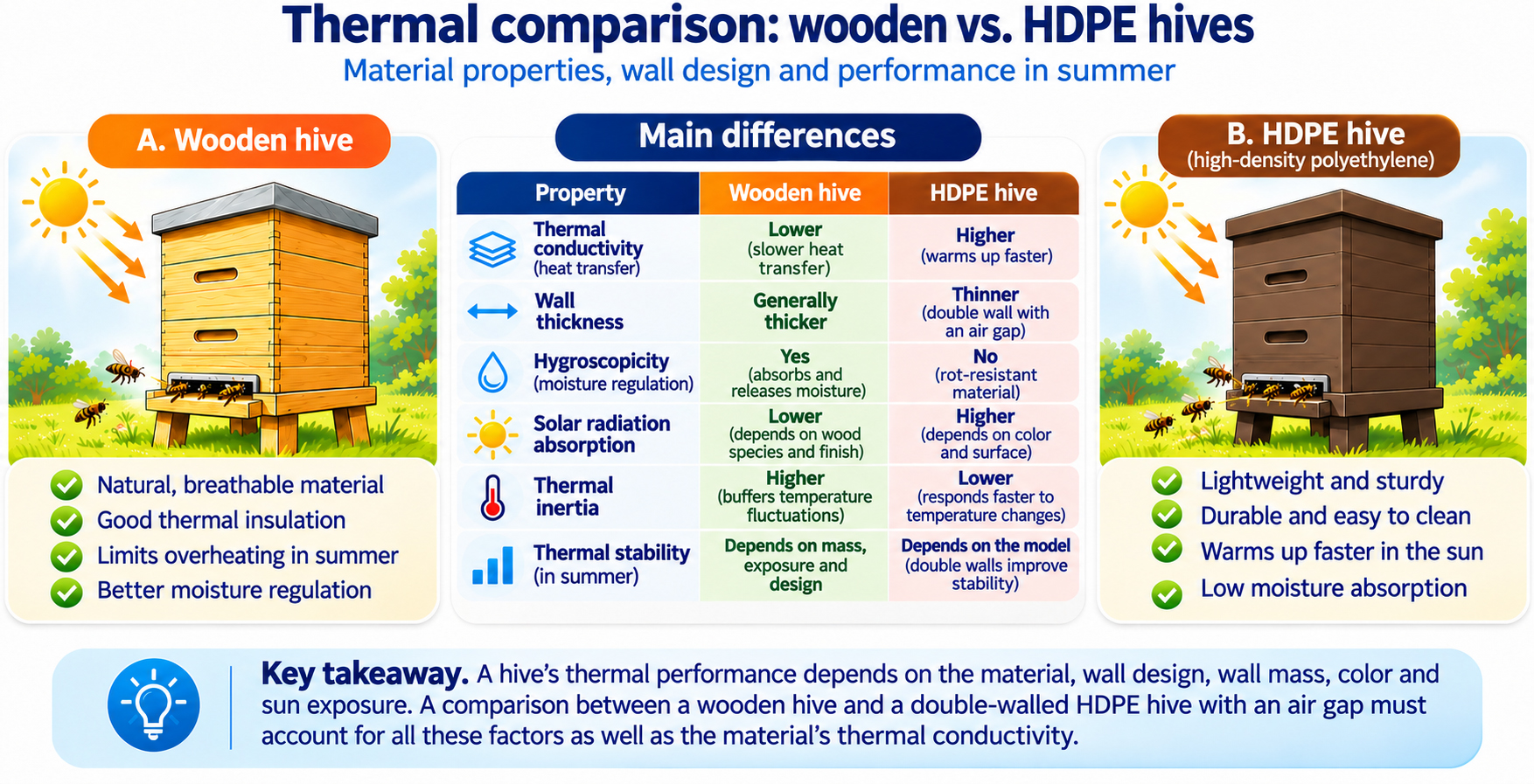
High-density polyethylene (HDPE) hives offer several advantages, including low weight, ease of cleaning, and resistance to weathering.
However, their thermal behavior depends greatly on both their design and their exposure to sunlight.
Dark-colored models absorb more solar radiation, which can lead to significant heating of the hive walls. Some hives feature a double-wall design with an integrated air gap that slows heat transfer. While this design may reduce heat loss during winter, its effectiveness in summer depends largely on the level of solar exposure.
Key takeaway: Plastic hives are not necessarily less suitable for hot weather conditions. Their color, design, and above all their location are decisive factors.
Wooden hives: a natural buffering effect
Traditionally used in beekeeping, wood offers interesting properties for limiting fluctuations in the hive’s internal microclimate. Its low thermal conductivity and thermal inertia help slow temperature changes, particularly when large temperature differences occur between day and night.
Wood also has hygroscopic properties: it can absorb and subsequently release part of the ambient moisture, helping to moderate fluctuations in humidity levels. However, these properties depend on the thickness of the wood, its maintenance, and its overall condition.
The roof is one of the hive’s surfaces most exposed to solar radiation. Its color and design can therefore have a major influence on hive heating.
Dark surfaces absorb more solar energy, while light-colored surfaces, particularly white ones, reflect a greater proportion of solar radiation.
The roofing material also plays a role: a metal roof heats up quickly, whereas a roof incorporating wood can slow the transfer of heat into the hive. Adding insulation beneath the roof may reduce heat gain, but it can also slow heat dissipation when outside temperatures drop.
Partial shading is another important management tool. By reducing direct solar radiation, it limits surface heating and can reduce the bees’ ventilation efforts.
To reduce thermal load, several measures can be combined:
Does a heavy roof provide better protection against heat?
A roof combining a metal sheet covering with a wooden structure can provide a thermal buffering effect. Although the metal sheet heats up rapidly in direct sunlight, the wood slows the transfer of heat into the hive thanks to its low thermal conductivity and thermal inertia.
Its weight can also improve roof stability in strong winds.
External insulation is another option for limiting temperature fluctuations. This approach is inspired by practices developed in regions with extreme climates.
In Gaspé, Canada, beekeeper John Forest developed external insulated hive enclosures known as “Forest Boxes”, originally designed to protect colonies from severe winter conditions. These wooden structures, lined with insulating materials, surround the hive and include openings that help, among other things, with moisture evacuation.
Field observations also suggest benefits during periods of extreme heat: external insulation slows heat transfer and helps buffer temperature peaks. However, this approach is not universally applicable. Its effectiveness depends on climate, ventilation, and the design of the system itself, while cost and bulkiness may limit its use.
Nevertheless, it illustrates an essential principle: protecting a colony from heat is not only about removing hot air, but also about reducing thermal fluctuations.
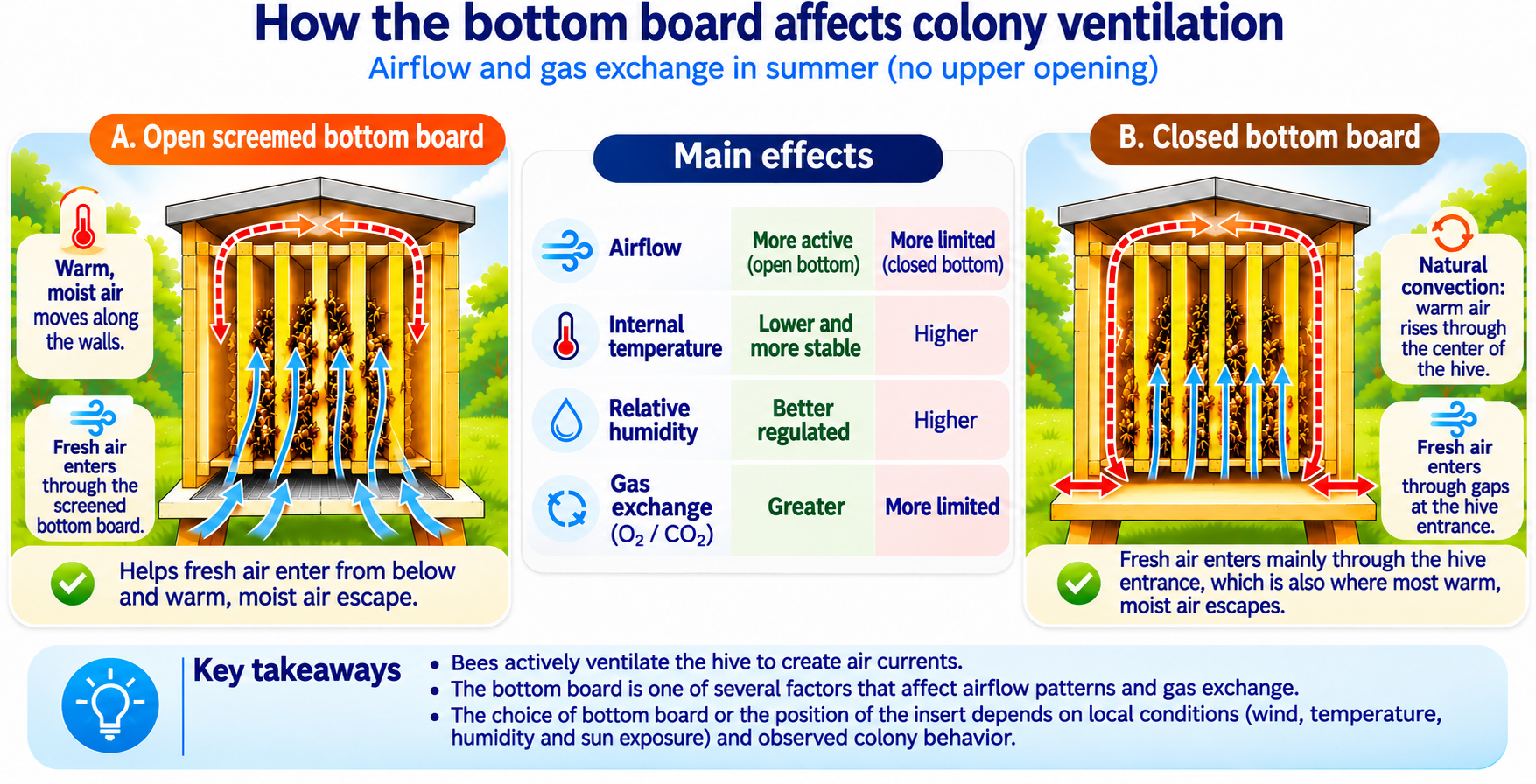
Screened bottom boards are widely used in beekeeping to facilitate Varroa monitoring and promote air and moisture exchange within the hive. However, their benefit during heatwave conditions remains a subject of debate.
Experimental studies indicate that colonies are generally able to maintain a relatively stable brood temperature with an open screened bottom board by adjusting their ventilation behavior and water consumption.
Keeping the bottom board open therefore does not appear to systematically compromise the bees’ thermoregulation capacity.
Note: Simplified diagram. In a real hive, airflow patterns are three-dimensional and constantly changing over time.
What field observations show
Under real-world conditions, the results are more nuanced. An open bottom board can promote air exchange and facilitate moisture removal. However, it may also increase exchanges with outside air that is hotter than the brood nest itself. Its effectiveness depends on several factors, including wind conditions, solar exposure, hive design, and colony activity.
So… Should the screened bottom board be left open?
To date, there is no scientific consensus demonstrating that an open or closed screened bottom board is systematically preferable during periods of extreme heat.
The position of the bottom-board insert should therefore be adjusted according to weather conditions, apiary location, and colony behavior, rather than following a universal rule.
High temperatures do not only affect the hive’s environment. They can also weaken internal hive structures, particularly the wax combs.
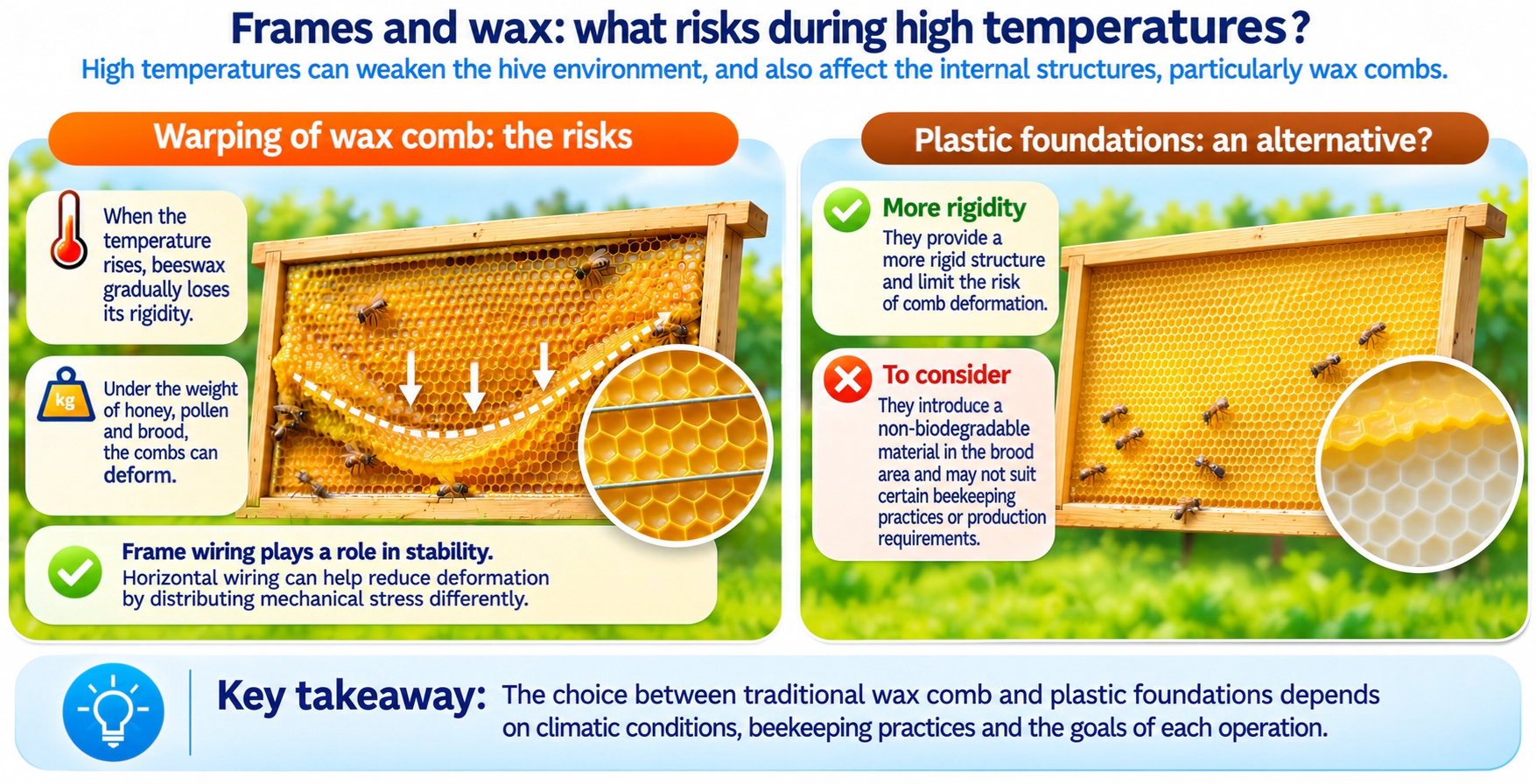
As temperatures rise, beeswax gradually loses its rigidity, even without reaching its melting point. Under the weight of honey, pollen, and brood, combs may become distorted, especially during heavy nectar flows combined with high temperatures.
Frame wiring contributes significantly to comb stability. In particular, horizontal wiring can help limit certain deformations by distributing mechanical stresses differently across the comb structure.
Plastic foundations, coated with a thin layer of beeswax, provide a more rigid structure and help reduce the risk of comb deformation.
However, they introduce a non-biodegradable material into the brood area and may not align with certain beekeeping practices or production requirements.
The choice between traditional wax foundation and plastic foundation therefore depends on climatic conditions, beekeeping practices, and the objectives of each operation.
In conclusion, when facing heatwave conditions, no single material or piece of equipment can provide a universal solution. A hive’s thermal resilience depends on the interaction between its design, its exposure to environmental conditions, the properties of its materials, and the bees’ own thermoregulatory abilities.
The choice of wood or plastic, the use of a light-colored roof, shading, insulation, and ventilation management should therefore be considered as complementary measures rather than standalone solutions.
The goal is not to artificially control the hive’s temperature, but rather to reduce the thermal stress that the colony must cope with.
Read the full article by Sébastien Cano in the November 2026 issue of Abeilles & Fleurs, and look out for Part 3 of this series, which will focus on the impact of heatwaves on honey bee colonies.
Further reading :
Brood Thermoregulation – Fahrenholz et al., 1989
Wood, Plastic and Insulated Polyurethane Honey Bee Hives…, 2021
Screened Bottom Boards and Thermoregulation – Sánchez et al., 2015
Illustrations generated using AI.
 by Véto-pharma
 by Caroline Lantuejoul