Beyond caring for their bees, one of a beekeeper’s key challenges is providing customers with high-quality honey. Quality is a major differentiating factor and an important guarantee of trust in a marketplace where poor-quality or adulterated products (fake honey) are increasingly common. Honey quality depends on many factors, from moisture content and sugar composition to botanical origin and storage conditions. Understanding the main honey analysis criteria helps beekeepers better understand their production, preserve product quality, and verify compliance with applicable standards. Moisture, HMF, diastase activity, electrical conductivity, acidity, and pollen analysis all provide valuable information about honey. Here is what these indicators mean and how to read them in practice.
Note: These limits come from EU regulation. Other countries apply their own rules, so check the standard that applies where you sell.
Color, texture, aroma, and flavor are the first characteristics used to evaluate honey. However, to characterize honey more precisely, it is also possible to analyze its composition and physicochemical properties in accordance with regulatory requirements.
A honey analysis can provide information about moisture content, sugar composition, acidity, enzymatic activity, and botanical origin. Some parameters are used to verify regulatory compliance, while others provide additional information about origin, aging, or storage conditions.
These analyses are therefore valuable tools for better understanding and managing honey quality. However, when receiving an analysis report mentioning terms such as “HMF,” “diastase activity,” “electrical conductivity,” or “melissopalynology,” it is not always obvious what to focus on.
Here are the main criteria to understand in order to better interpret what honey analyses can reveal.
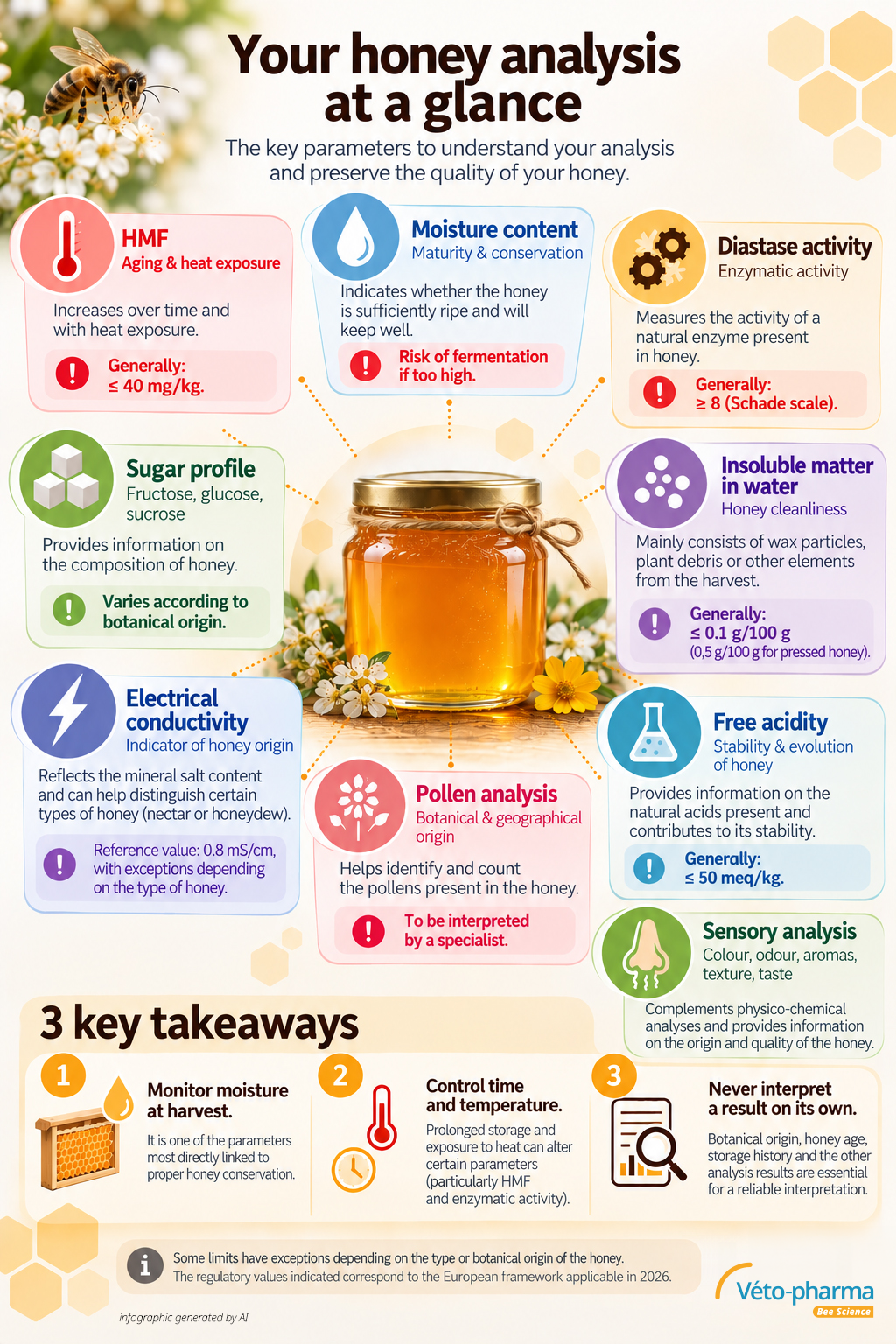
Moisture content is probably one of the most useful parameters to monitor. Also referred to as water content, it plays a major role in the stability and shelf life of honey. Honey containing excessive moisture is more susceptible to fermentation, as naturally occurring yeasts can develop under favorable conditions.
For most honeys, European regulations set a maximum moisture content of 20%. Specific limits apply to certain honey categories, particularly heather honey (Calluna vulgaris), for which the maximum permitted moisture content is 23%.
In practice: The goal is not simply to remain below the 20% legal limit. The closer moisture content is to this threshold, the more attention should be paid to storage and preservation conditions. In practice, a “safety threshold” of 18% is commonly considered preferable because the risk of yeast fermentation increases significantly above approximately 18-18.5% moisture. For optimal storage and texture, the ideal moisture range is generally considered to be between 17% and 18%.
Why measure honey moisture content?
Monitoring moisture content helps to:
Moisture content can be measured using a honey refractometer.
Key takeaway: A good moisture management strategy begins at harvest. Harvesting sufficiently ripened honey and protecting it from humidity during extraction and storage directly contributes to preserving quality.
Honey naturally contains small quantities of water-insoluble matter such as wax particles, plant debris, and other materials introduced during harvesting and extraction. The measurement of water-insoluble matter provides an indication of honey cleanliness and the quality of post-harvest processing, including extraction and filtration practices.
For most honeys, European regulations establish a maximum level of 0.1g of water-insoluble matter per 100g of honey. A higher limit of 0.5g/100g applies to pressed honey. High values may indicate a significant presence of particles originating from combs or from handling during extraction and packaging operations.
Consequently, good extraction, filtration, and storage practices play a direct role in controlling this parameter.
Key takeaway: Water-insoluble matter provides useful information about honey cleanliness. Careful extraction and appropriate filtration help minimize the presence of unwanted particles.
HMF (hydroxymethylfurfural) is a compound whose concentration increases naturally as honey ages and when it is exposed to heat. Fresh honey stored under appropriate conditions generally contains low levels of HMF.
Under European regulations, the maximum HMF content for most honeys is 40mg/kg. A specific limit of 80mg/kg applies to honey originating from tropical regions and blends containing such honey.
HMF is therefore particularly useful for assessing a honey’s thermal history and storage conditions.
High HMF values may indicate prolonged storage or significant heat exposure.
Beware of the time-temperature relationship. When honey must be liquefied or gently warmed to facilitate handling, temperature is not the only factor to consider. The duration of heat exposure is equally important. Even moderate temperatures can alter honey characteristics if applied for extended periods.
Key takeaway: To preserve honey quality, both heating temperature and heating duration must be carefully controlled.
Honey naturally contains several enzymes produced by bees. One of them is diastase, whose activity can be measured in the laboratory.
The diastase number (diastase activity) provides an indication of this enzymatic activity, which may decrease over time and under the effect of heat.
As a general rule, European regulations require a diastase activity of at least 8 on the Schade scale.
However, exceptions exist for naturally enzyme-poor honeys, such as certain citrus honeys.
HMF and diastase activity provide complementary information:
Key takeaway: A low diastase activity value is not automatically a sign of poor-quality honey. The botanical origin and the natural characteristics of the honey must always be considered when interpreting the results.
Honey is primarily composed of sugars, particularly fructose and glucose.
Their proportions naturally vary depending on the honey’s botanical origin and contribute to many of its characteristics. In particular, the fructose-to-glucose ratio influences the honey’s tendency to crystallize. Analysis of a honey’s sugar profile helps characterize its composition and assess whether it is consistent with its declared origin and expected quality. Sucrose is also one of the sugars monitored during analysis. An unusually high concentration may warrant further investigation. Here again, interpretation must take the honey’s botanical origin into account, as the natural sugar composition varies among honey types.
More advanced analyses may also be used to detect exogenous sugars when assessing honey authenticity.
Key takeaway: There is no single sugar profile that applies to all honeys. Results should always be interpreted in light of the honey’s botanical origin.
Electrical conductivity measures honey’s ability to conduct an electrical current. It is influenced by its content of minerals, organic acids, and other compounds. Although this parameter may seem far removed from practical beekeeping, it is particularly useful for differentiating certain honey types.
As a general rule, nectar honeys have an electrical conductivity of 0.8mS/cm or less, whereas honeydew honeys and chestnut honey typically exhibit conductivity values above this threshold. However, several exceptions exist depending on botanical origin.
In practice: Electrical conductivity should be considered one indicator among many, not a standalone criterion for determining the origin of a honey.
Honey is naturally acidic. The organic acids it contains contribute to its flavor profile, stability, and certain functional properties. Laboratory analyses measure its free acidity.
For honey marketed as such, European regulations generally establish a maximum value of 50 milliequivalents of acid per kilogram. An unusually high acidity level may indicate product deterioration or the onset of fermentation.
In practice: As with other analytical parameters, acidity results should always be interpreted alongside the honey’s other characteristics.
Pollen analysis, also known as melissopalynological analysis, consists of identifying and counting the pollen grains present in a honey sample.
It provides valuable information about the honey’s botanical and geographical origin.
This type of analysis is particularly useful when honey is marketed under a floral designation such as acacia honey, lavender honey, or chestnut honey.
It is important to note that the number of pollen grains present is not always directly proportional to the amount of nectar collected from a given plant. Some plant species naturally produce pollen that is overrepresented or underrepresented in honey.
As a result, pollen analysis should be interpreted by a specialist and considered alongside the honey’s other characteristics.
Honey evaluation does not stop at laboratory measurements. Color, aroma, flavor, taste, and texture also provide valuable information. This sensory assessment helps determine whether a honey displays the characteristics expected for its botanical origin and can reveal possible defects or unusual features.
Several complementary approaches can be combined to characterize honey origin:
Together, these methods provide a more complete understanding of the product.

Today, honey authenticity is a major issue for the beekeeping sector. Specialized laboratories employ advanced analytical methods capable of detecting the possible presence of exogenous sugars or determining whether a sample’s composition is consistent with that of authentic honey.
Among the methods commonly used are:
These techniques can help identify potential honey adulteration, including poor colony feeding practices, such as feeding syrup or fondant during nectar flow periods, or situations where colonies have foraged on exposed industrial sugar products.
It is not necessary for beekeepers to fully understand the scientific principles behind each technique. Their primary purpose is to provide additional information for assessing honey authenticity. For example, ¹H-NMR generates a highly detailed compositional fingerprint that can be compared with databases of authentic honey samples.
In practice: These specialized analyses do not necessarily need to be performed on every batch. Their use depends on the context and the specific objective being pursued.
Not all analyses serve the same purpose. Before submitting honey for testing, the first question should be: What exactly do I want to verify?
Shelf-life and storage stability? Regulatory compliance? Botanical origin? The cause of an anomaly? Honey authenticity?
To gain a better understanding of production quality, the following analyses are often particularly valuable:
Depending on the honey type and marketing claim, pollen analysis and/or sensory evaluation may provide useful complementary information. More advanced authenticity testing addresses specific needs.
This is perhaps the most important point to remember: No analytical result should ever be interpreted in isolation.
A value approaching a regulatory limit does not necessarily indicate poor-quality honey. Conversely, compliance with a single parameter is not sufficient to characterize overall honey quality.
To correctly interpret analytical results, several factors must be considered:
Honey analysis should therefore be viewed as a set of complementary indicators rather than a collection of independent values.
Analyses help measure and better understand honey quality, but quality is established first and foremost through good beekeeping practices.
Understanding the environment surrounding the apiary, harvesting at the right time, controlling moisture, maintaining high hygiene standards, minimizing unnecessary heat exposure, and storing honey under appropriate conditions all contribute to preserving its characteristics.
Honey analysis then becomes a valuable monitoring tool, allowing beekeepers to better understand their honey, identify potential points of concern, and maintain product quality all the way through to market.
Further Reading:
 by Véto-pharma
 by Véto-pharma