by Véto-pharma
 September marks a turning point in the apiary. A special generation of bees is beginning to emerge: winter bees. Unlike summer bees, which live for only a few weeks, these bees will live for several months. They will be responsible for maintaining cluster temperature throughout winter and for rearing the first brood in early spring. Their quality, and therefore the colony’s survival, is being determined now.
Three factors affect this generation at the same time: Varroa pressure, nutritional reserves and predation by asian hornet (the yellow-legged). These factors are closely interconnected and all converge on the same critical objective: the colony’s ability to produce and protect healthy winter bees. Addressing them separately risks overlooking important interactions. Here is how to tackle them together.
Winter bees are vulnerable for a specific reason. Varroa destructor reproduce in the last brood cycles of the season, feed on the bee’s fat body, its main metabolic resource, as well as its hemolymph, and transmit viruses, foremost among them Deformed Wing Virus (DWV).
The impact is twofold. The parasite directly weakens individual bees while simultaneously depleting the lipid and protein reserves stored in the fat body. These are precisely the reserves winter bees rely on to survive until spring. Colonies entering winter with high mite loads often produce prematurely exhausted winter bees.
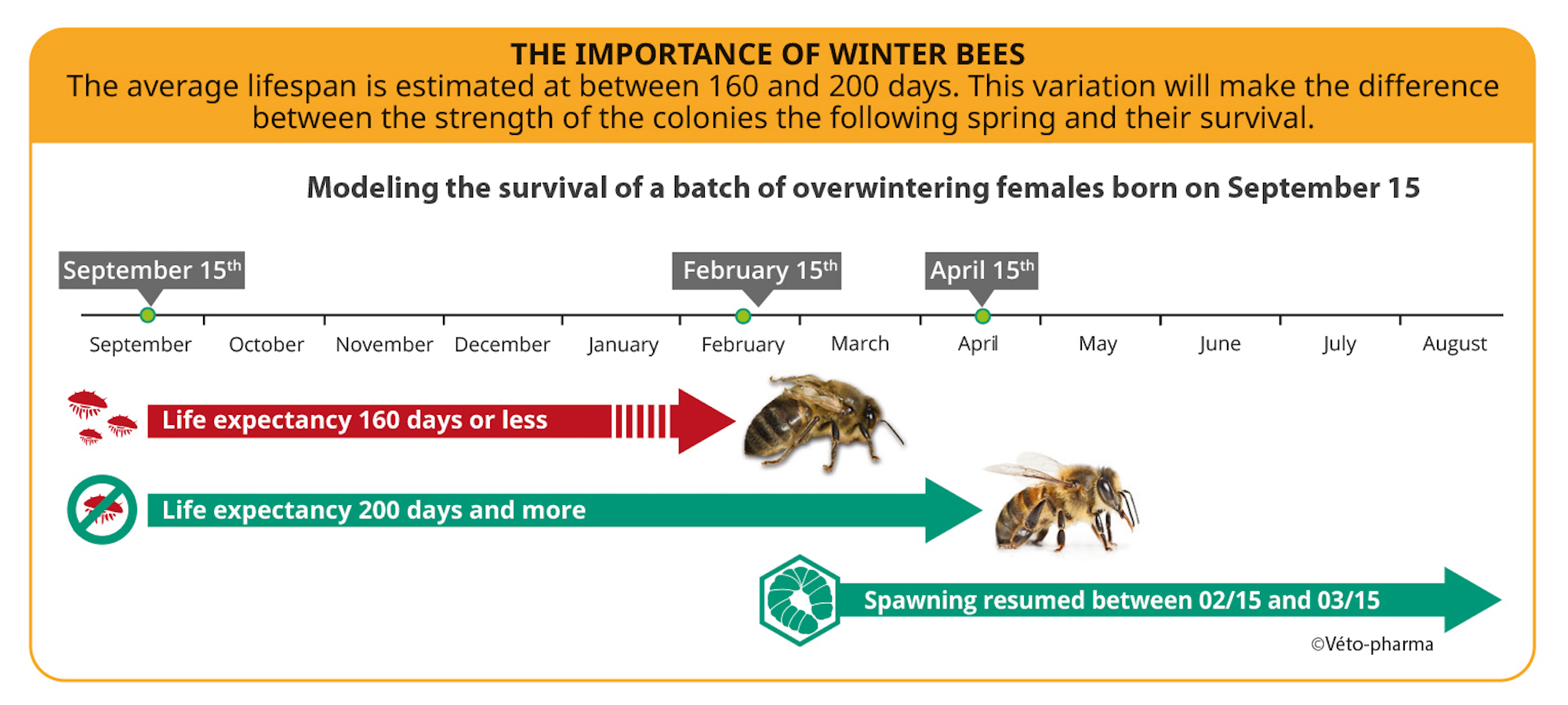
Another point to keep in mind is that Varroa damage is not always visible to the naked eye. The viral load transmitted by the mite can have a major and lasting impact on a colony, even after treatment, because viruses can persist for several weeks once the parasite has been brought under control. For this reason, intervention should never be delayed until the last minute. The most effective strategy is not a single end-of-season treatment but rather an integrated management approach implemented throughout the year. This combines biotechnical methods such as drone brood trapping, queen caging, and brood removal with appropriate acaricide treatments, always maintaining infestation levels as low as possible.
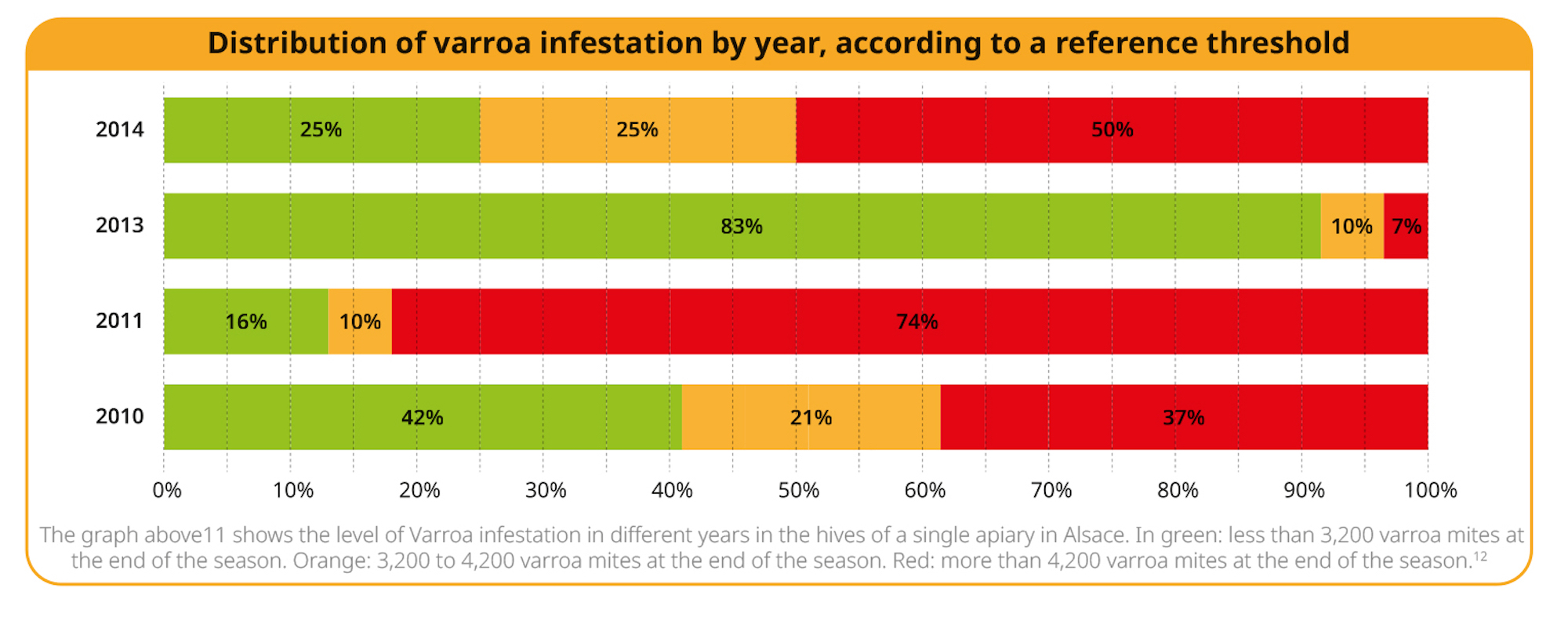
In practice, a common mistake is to treat according to the calendar without knowing the infestation level. The right reflex is to measure first. Counting phoretic Varroa mites using an alcohol wash, sugar roll or CO2 injection provides a reliable picture of the situation. A tool such as Varroa EasyCheck makes this process quick and reproducible from one inspection to the next. Infestation levels vary enormously from year to year and from hive to hive: within the same apiary, some colonies may have fewer than 500 mites at the end of the season while others contain several thousand. Applying the same routine to such different situations will not produce the same result.
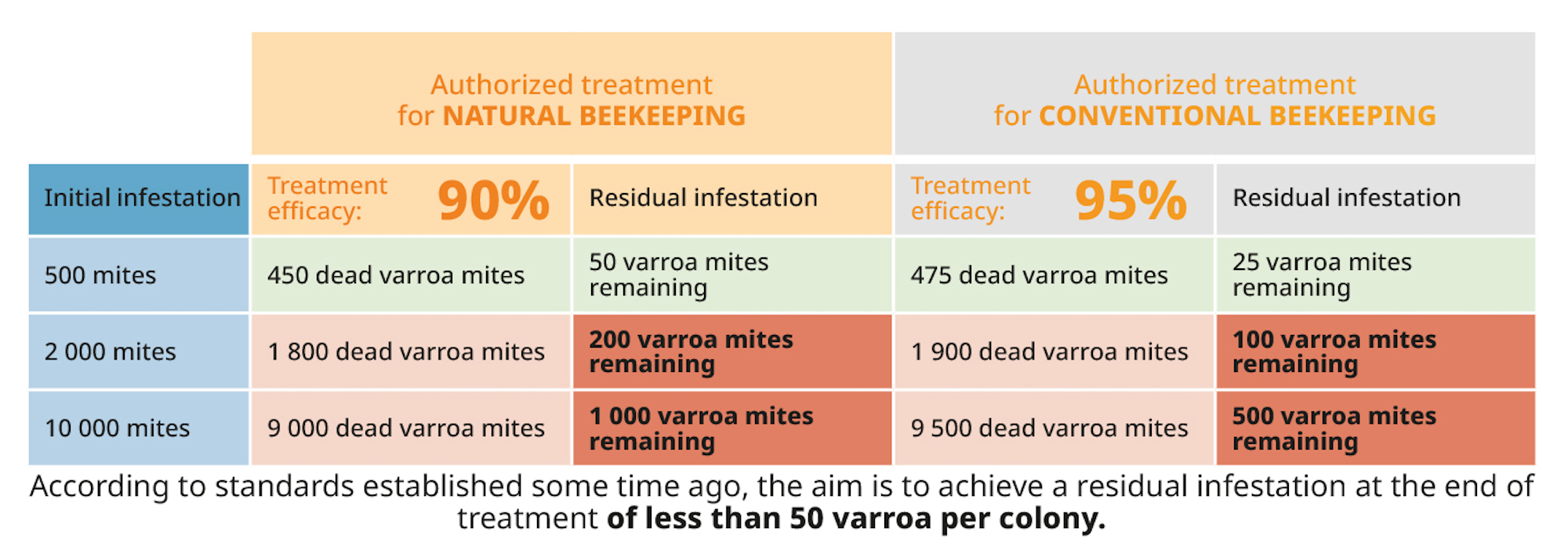
Be careful not to confuse treatment efficacy with the final outcome: even a treatment that is 90 or 95% effective leaves a residual infestation proportional to the initial mite load. In a heavily infested colony, that residual level may still be high. This is why it is important to check efficacy with another count after treatment and to remain alert to the risk of reinfestation through robbing or drifting from neighboring apiaries.
Finally, end-of-season treatment is not always enough. Increasingly, it can be useful to supplement it with a winter oxalic acid treatment applied during a broodless period to target residual mites populations later in the season. This follow-up is particularly effective when the colony is broodless. However, milder winters are making this natural brood break less predictable and sometimes nonexistent, which means colony biology must be monitored closely rather than relying solely on the calendar.
To help you build an effective Integrated Varroa Management strategy, download our guide “Integrated Varroa Management Throughout the Seasons“, co-authored with Dr. Gérald Therville, veterinarian and specialist in honey bee health and pathology.
A healthy winter bee is also a well-nourished bee. Winter bees store protein reserves in their fat body and produce vitellogenin, a storage protein derived from pollen that supports immunity, longevity and the ability to rear brood. It is a defining feature of the winter bee’s distinctive metabolism. There is a direct relationship between the reserves built up at the end of summer and the colony’s winter survival.
The problem is that late summer often means scarcity: little pollen is available, while Varroa is depleting fat-body reserves. Syrup meets carbohydrate needs, but it does not address the protein requirements of the last brood cycles, the very brood that produces winter bees. Where pollen is lacking in quantity or quality, a protein supplement such as MegaBee, which is high in protein and micronized for good assimilation, can help support late-season brood rearing.
A practical point from apiary management: to be useful, protein supplementation should ideally be maintained for long enough around four to six weeks, or approximately two brood cycles to establish a positive cycle and cover the generation of winter bees.
To learn more, you can download our guide “Honey Bee Nutrition”, co-written with Antonio Pajuelo, a specialist in honey bee nutrition.
Long regarded as a French problem following its introduction in 2004, the asian hornet (Vespa velutina) has become an international issue. In Europe, it has recently been reported in Austria, Ireland, Luxembourg, the Netherlands and Slovakia. In the United States, the first detection in the open environment occurred in Georgia in August 2023, and eradication campaigns are ongoing. Even more significant for the Southern Hemisphere, New Zealand detected the species on its territory for the first time in October 2025 on Auckland’s North Shore, with eradication efforts still underway in early 2026.
Why such vigilance? Because hornet pressure on colonies is far from insignificant. A French study estimated that a single nest can consume an average of 11.32 kg of insect biomass over a season, with honey bees accounting for around 38% of its diet. More importantly, when hornet colonies are populous, large numbers of individuals capture foragers as they return to the hive, causing foraging activity to become paralyzed and potentially leading to colony collapse. The Western honey bee, which did not co-evolve with this predator, lacks the effective defenses found in Asian honey bee species.
Mortality figures vary by region and study, but they are striking. In some European regions, predation has led to the loss of nearly 50% of hives, while beekeepers in southwestern France have reported losses of 30 to 80% of their colonies. In one apiary monitored under experimental conditions, one of six hives was completely destroyed and the populations of the other five were reduced by half. The link with nutrition is direct: by suppressing foraging precisely when the colony needs to build its winter reserves, the hornet worsens nutritional deficits at the worst possible time.
Autumn is the period of greatest pressure. Protection relies on several complementary measures: reducing hive entrances, using protective devices around the landing board, and trapping around the apiary. VespaCatch Original and VespaCatch Select traps fit into this approach, with the latter designed to limit non-target captures—an important consideration because poorly selective trapping can also harm beneficial insects. Trapping remains one tool among others: in cases of heavy predation, it is advisable to combine it with other devices such as hive muzzles or electric harps.
These three issues are really one. A high-quality winter bee needs all three conditions to be met: low Varroa levels, sufficient reserves and an apiary protected from hornet predation. Each affects the others. Uncontrolled Varroa spreads viruses through the colony and depletes fat-body reserves. Active hornets suppress the foraging needed to replenish those reserves. And a poorly nourished colony is less able to withstand everything else, from parasites to viruses.
What connects all of this is anticipation. Effective management is not about a last-minute intervention, but a series of decisions made at the right time throughout the season and adjusted to the realities of the current year. Every year is different, and climate change only increases this variability: milder winters, longer late seasons, and shifting parasite and predator pressure. Take the time this month to assess all three factors. The colony you will find next spring is being prepared now.
 by Véto-pharma
  by Véto-pharma